Your products, readable everywhere.

Barcodes, ECCnet product records and GS1 QR codes for food brands across Canada. We take care of it, from the number to the page.

Scan it with your phone. It's a real demo: the code opens the page of a fictional product.
See what the phone sees

The barcode stops at the beep. The QR code doesn't stop there.

One gives a number at the till. The other gives the same number, plus a page you can change whenever you want.

A web address, built to a rule.

  1. id.yourbrand.caYour domain. The page belongs to you.
  2. /01/The GS1 rule: what follows is a product number.
  3. 09506000134352Your GTIN. The same number as your barcode.

A 2D-ready checkout reads

09506000134352

Just the number. No internet. Beep.

Checkouts in Quebec don't read this code yet, and GS1 Canada names no Canadian retailer that does. Your current barcode stays on the pack.

The label is printed once. The page changes whenever you want.

A summer recipe, a new size, the stores that carry you, a contest, a recall notice: tell us what to change and we update the page within one business day, without reprinting a single label.

It's the only part of your packaging that can still change after it's printed. And it works today, on any phone.

What stays on the pack.

The code replaces nothing. Ingredients, allergens and the Nutrition Facts table stay printed, in English and French, as federal rules require across Canada. The page adds to the label. It never takes anything off it.

Your data, ready when Loblaw, Sobeys or Metro ask for it.

According to GS1 Canada, selling to Loblaw, Sobeys or Metro means having your products in ECCnet, its product registry. We load your data, follow it through to publication and arrange for your samples to get to GS1 for photos.
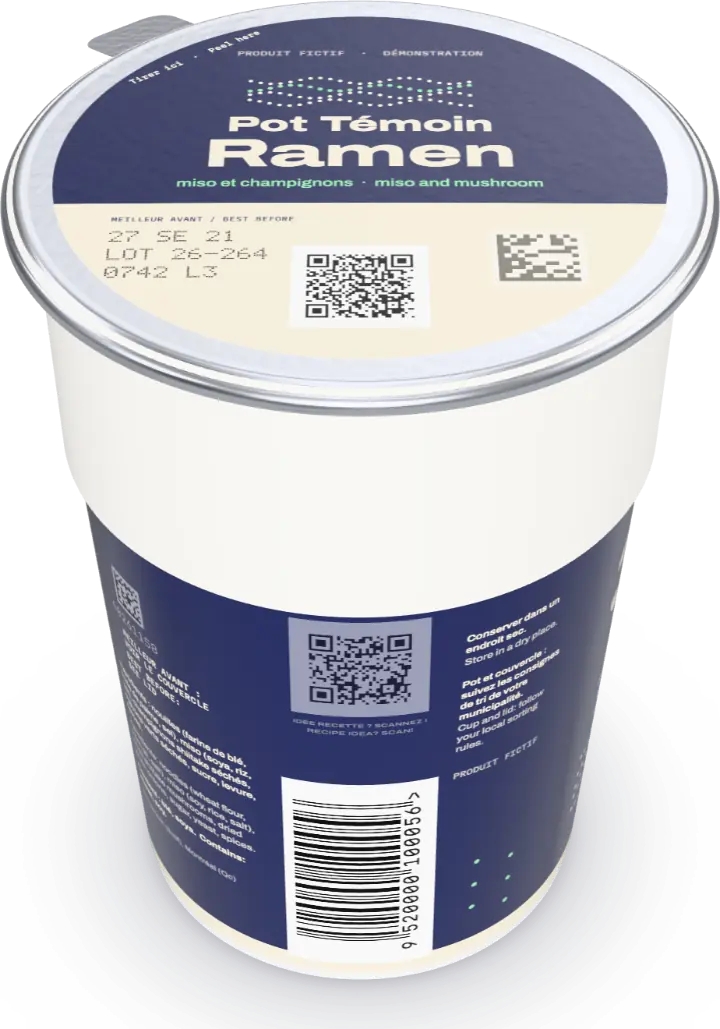
One cup, five codes

This noodle cup copies where the codes sit on a real pot sold in the UK, where five can be spotted; many packs here carry fewer.

The fictional noodle cup seen from above: on the lid, one GS1 QR code beside the printed date and batch, the barcode on the side, and, paler, the QR code and the small Data Matrix codes a GS1 code can gather.
  1. The front, no codes

    The brand is made up, but the codes sit where they do on the real pot. They are on one side, the back and the lid.

  2. Probably a code for the factory

    This small square is a Data Matrix code: on the real pot, it holds only an eight-digit number. Codes like this often serve the factory, where a camera checks that the right packaging is loaded.

  3. The same number, twice

    On the real pot, this second square repeats the first one's number, also printed in digits just below it. The date and batch are plain text on the lid, and no checkout can read them.

  4. The barcode

    It carries a single number, the GTIN, which identifies the product at the checkout. Its format leaves no room for the batch or the date.

  5. A QR code for shoppers

    On the real pot, it is already a GS1 QR code: it carries the same number as the barcode and opens the brand's website. It holds neither the batch nor the date, though.

  6. Another one on the lid

    On the real pot, the lid has its own code, with a different eight-digit number. Codes like this are often used to check that the right lid goes on the right pot.

  7. What one code can gather

    One GS1 QR code can carry everything this pot scatters, barcode included: the product number, the batch, the date, a web page, and technically even a factory's internal number. In practice, factories often keep their own codes. In the UK, a major chain already sells products with the QR code alone; in Canada, the barcode stays on the pack for now.

What we do for you

Your barcodes, checked

We check your GTINs, then the size and placement of every barcode in your files, before anything goes to the printer.

You get a one-page report, code by code.

Your ECCnet records, published

We load your product data into ECCnet, fix whatever is holding up validation and follow the records through to publication for your retailers. Loblaw, Sobeys and Metro require it, though it doesn't guarantee a listing. GS1 Canada bills its fees to you directly, and we add no markup.

You get published records your retailers can look up.

Your GS1 QR code, with a living page

A QR code on your own domain that opens a product page in English and French. Recipes, new sizes, where to buy, promotions: you tell us what to change, we update the page within one business day, and nothing gets reprinted. We check it against the same rules as your label. The first 12 months are included; after that it's $600 a year for up to five products, changes included. If you stop, we hand you the page's files, and it stays on your domain.

You get a print-ready file for your printer, and the page, live.

Your label, read before it prints

We read your label against the two sets of rules that apply: the information the federal regulations require in both English and French on a consumer prepackaged food, and the French required by the Charter of the French language, which may be neither less prominent nor harder to reach than another language. We tell you what has to change, and what can stay as it is, while the file can still be changed. The mandatory information stays printed on the pack: the product page adds to it, it doesn't replace it. This is a review, not legal advice and not a certification.

You get a list of corrections, line by line, before the print run.

What it costs

From $2,500 for a range of five products. That price, fixed once quoted, covers all of our work: GTINs and barcodes verified, ECCnet record published, label reviewed, GS1 QR code and product page live.

GS1 Canada's own fees are not part of our price: you pay them to GS1 directly, and we never mark them up. They depend on how many products you have; the prices GS1 publishes are laid out in our ECCnet guide. After 12 months, the product page is $600 a year for up to five products, changes included.

The first week

  • Your barcode report, code by code.
  • Your product page, live. Scan the code and your phone opens it.
  • Your data in ECCnet if ProSYNC access is already active, and your samples ready to ship to GS1 Canada.

The 2D code, without the hype

  1. Already required, elsewhere

    In Quebec, 2D codes have been required on cannabis since 1 January 2025, and the old linear code was dropped there on 1 January 2026. Nothing of the kind exists for food.

  2. Today, in food

    The GS1 QR code already opens on any smartphone. Checkouts in Quebec don't read it yet, and GS1 Canada says many Canadian retailers are still assessing whether their systems are ready.

  3. End of 2027, for retailers

    Ambition 2027, also called Sunrise 2027: GS1's global goal for retail checkouts to be able to read 2D codes. It's a target for retailers, not an obligation for brands. GS1 Canada calls the switch voluntary.

  4. After that

    That's where the industry is heading. In the UK, Tesco announced in April 2026 that its own-label sausage range was moving to a QR code alone. In Canada, your current barcode stays on the pack until checkouts can read 2D codes everywhere, and no removal date has been announced.

What it does

  • It opens on any phone, without an app.
  • The page lives on your domain, and it can change without a reprint: tell us what to change and it's done within one business day.
  • It carries your GTIN, the same number as your barcode.

What it doesn't do

  • Checkouts in Quebec can't read it yet, and GS1 Canada names no Canadian retailer that can.
  • It doesn't replace your barcode. Both stay on the pack, and no removal date has been announced.
  • It isn't mandatory. No law requires it.

The best time to add it is your next print run. It takes a little room next to the barcode, and not much else.

If you would rather understand it first

One person who answers

Nitide was founded in Montreal by Matteo Jam. Every project has one named person in charge, who answers in writing at contact@nitide.ca and calls you at a time you chose, never out of the blue. That same person signs off on the work. We work in French first, and English-speaking brands from anywhere in Canada are welcome. You keep everything: your domain, your files, your data.

nitide \ni.tid\ adjective, rare

A rare French adjective, from Latin nitidus: shining, clear, well kept. Said “nee-teed”, rhyming with the French limpide.

Fifteen minutes to look at your products.

Tell us what you sell and where you want to sell it. We'll tell you what's missing.

Book 15 minutes

or write to contact@nitide.ca